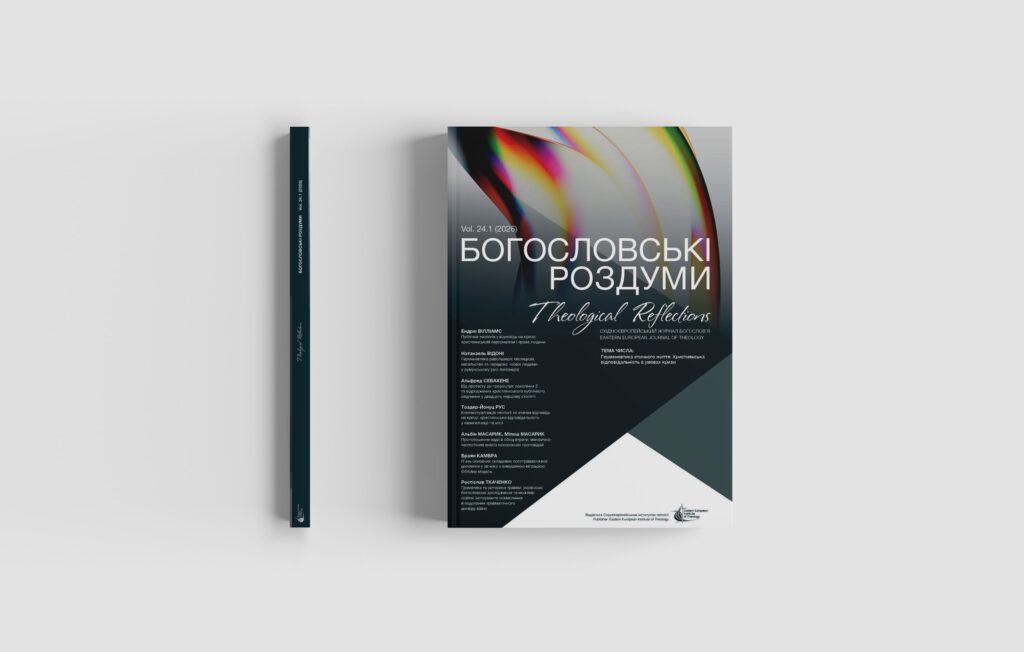


Call for Papers 2026 Fall Issue: The Role of Christian Imagination in Resisting Injustice and Violence
The editorial board of Theological Reflections: Eastern European Journal of Theology invites authors to submit articles for the Fall 2026 issue (vol. 24.2). This issue will explore the role of imagination in shaping a theology that is attentive to socio-political challenges and capable of resisting systems that stir up violence and social injustice.
Although discussions about the formative power of imagination have been ongoing for centuries, theology today is rediscovering its potential, particularly for understanding the political sphere. This raises the question of how images that surround us – and our perception of reality – influence not only theological reflection but also the formation of political thought.
The hermeneutical turn in the second half of the twentieth century renewed interest in imagination across the humanities. It emphasized that human existence in the world is inseparable from interpretation. Because being itself is a mystery, interpretation of the world always grapples with the ambiguous, contradictory, and ineffable – elements we creatively integrate into a coherent picture of the world. For this reason, our interpretation of the world is always intertwined with our capacity to imagine it.
In this context, the Christian worldview emerges as a unique way of perceiving reality. It enables us to see not only the intangible “depth” of the present world, but also the “depth” of its future, which we cannot yet see – that is particularly evident in eschatological imagery. Christian imagination interprets and portrays the world and the divine presence within it, which inspires a vision of a future filled with hope and love.
At the same time, it challenges us to imagine possible forms of communal life “here and now” that respond attentively to people’s needs and confront political injustices.
Historical experience also shows that Christian imagery has often been used to justify injustice, contributing to the development of “unhealthy theologies” that legitimize socio-political systems of violence and oppression. For this reason, one of the tasks of theology is to foster a Christian imagination capable of critically rethinking such images and resisting these systems. In doing so, theology can contribute to the formation of a more just social order.
We invite authors to submit academic papers that turn to the experience of Eastern Europe. We also welcome research relevant to the Eastern European context.
Suggested topics for submission are listed below; however, authors are encouraged to submit papers on other topics that relate to the issue’s theme – the interconnection between theology and imagination:
The editorial board invites submissions of original articles, essays, and book reviews on this topic. Articles should not exceed 7,000 words (including references and bibliography). Book reviews should be up to 1,500 words for extended critical reviews and up to 500 words for shorter descriptive reviews.
The submission deadline is September 15, 2026. The issue will be published online on December 15, 2026.
To submit an article or review, please upload it to the journal's website at http://reflections.eeit-edu.info/about/submissions. Guidelines for authors are available here http://reflections.eeit-edu.info/guidelines. Should you have any questions, please contact us by e-mail: reflections@eeit-edu.info.
NB! The Spring 2027 issue will focus on the role of AI in theology.