

Christian Responsibility During a Crisis: A New Issue of “Theological Reflections” Is Now Available Online
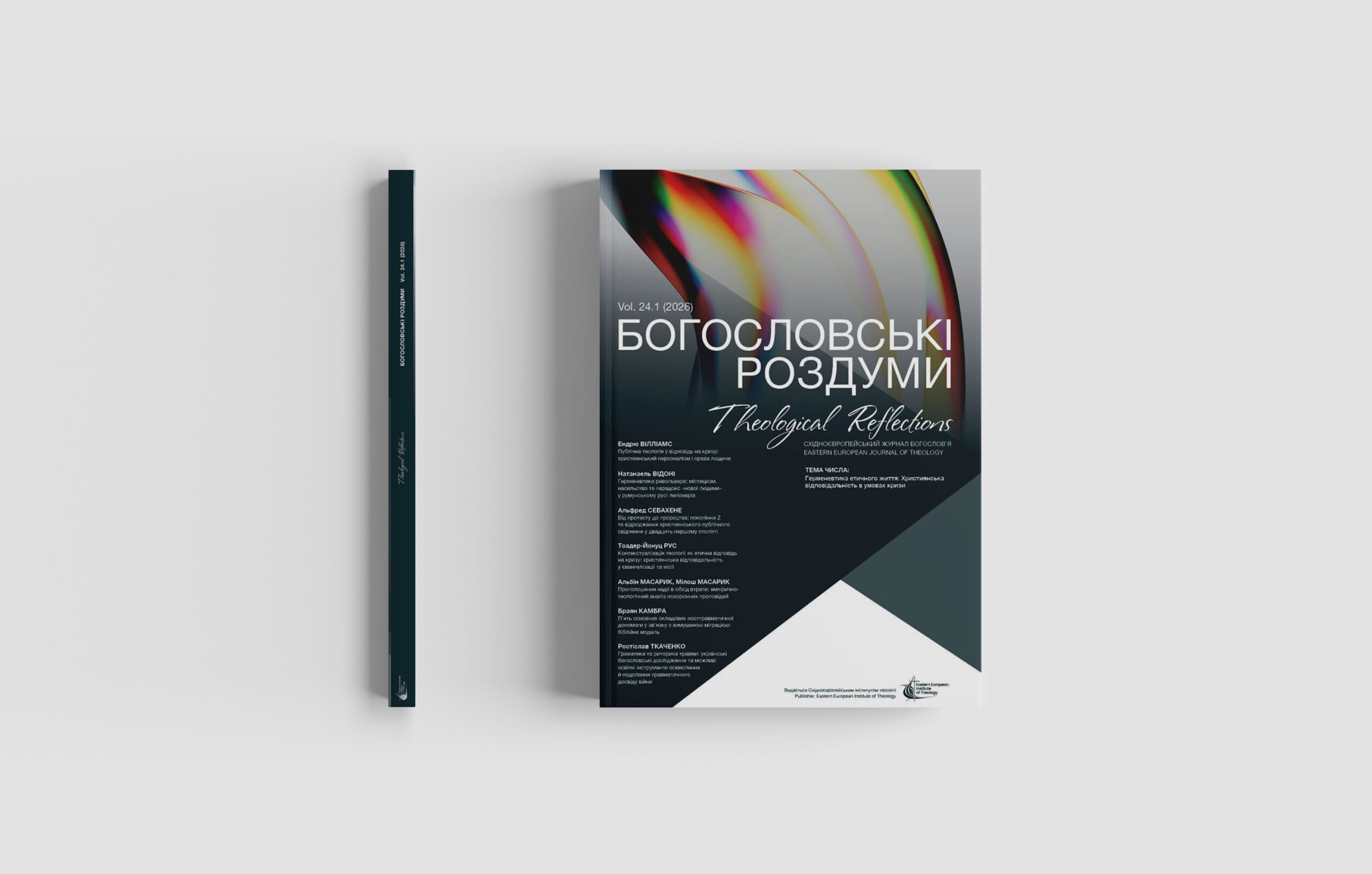
Dear authors and readers of “Theological Reflections: Eastern European Journal of Theology,” we are pleased to announce that the new issue (Spring 2026) is now available on the journal’s website via the updated link https://journal.eeit-edu.info.
For this issue, the journal’s editorial board invited authors to submit scholarly articles analyzing the development of theological thought in response to crises. The focus is on how challenging circumstances prompt a reevaluation of traditional principles and practices, as well as give rise to new theological reflections and approaches.
As a result, this issue includes seven scholarly articles in philosophy and theology, political theology, missiology, and applied theology. Particularly noteworthy is the fact that the Eastern European context explored by the authors is examined from diverse cultural and geographical perspectives. For example, Alfred Sebahene, a native of Tanzania, drawing on his personal experiences in both Africa and Europe, invites readers to reflect on the socio-political role of Generation Z in the Church’s mission, a mission that goes beyond geographical boundaries.
In his article, Andrew Williams examines the crises brought about by World War I and World War II, which stimulated the development of public theology and, in turn, contributed to the emergence of the concept of human rights, particularly through the adoption of the Universal Declaration of Human Rights. This study is especially relevant today, as human dignity is subjected to systematic violence and humiliation amid Russia’s aggression against Ukraine.
In addition, the issue features research by two PhD students from the University of Bucharest. Natanael Vidoni further develops the theme of political theology and the public role of the Church in interwar Romania by analyzing the interaction and tensions between the Romanian Orthodox Church and the radical nationalist far-right movement known as the Iron Guard. Drawing on the Romanian context, Toader-Ionuț Rus examines the Church’s responsibility and mission in the face of contemporary religious challenges arising from postmodern thought, particularly the relativization of truth and the crisis of authority. According to the author, these developments have become some of the key challenges to the Church’s evangelizing mission in the modern world.
The following three articles focus on the applied dimension of theology, particularly on issues of special relevance to the current situation in Ukraine during the war. Albin and Miloš Masarik present an empirical-theological analysis of sermons delivered during funeral liturgies. Their article demonstrates how sermons can at times deepen the pain and experience of loss; however, when pastoral approaches are reconsidered, they can also become a source of support that affirms hope in the resurrection while remaining sensitive to the reality of grief.
Brian Cambra addresses the issue of overcoming the trauma of forced migration caused by war, natural disasters, or persecution on religious, political, ethnic, or other grounds. Drawing on the example of the Babylonian Exile, the author argues that contemporary secular approaches to trauma recovery have deep roots in the theological concepts found in biblical narratives.
Rostislav Tkachenko’s article explores how the Ukrainian theological and religious community, particularly the evangelical community, is discovering a new field of theological inquiry – the theology of trauma – amid the war. The author provides an overview of a substantial body of research conducted over the past four years by various scholars and outlines opportunities to integrate these findings into seminary curricula to cultivate religious communities that are sensitive to the traumas of wartime life.
In addition, this issue includes eleven scholarly reviews of recent theological publications that engage with important debates in contemporary theology. Two of these are brief reviews of recently published books.
We sincerely thank the authors for their high-quality research, their careful consideration of the reviewers’ comments, and their patience and dedication throughout every stage of preparing this issue. We also extend our heartfelt gratitude to the reviewers for their professional recommendations and insightful feedback, which have contributed greatly to improving the quality of the articles. Special thanks go to the literary editors for their careful attention to detail and significant contribution to the preparation of this issue, as well as to the entire team of "Theological Reflections" for their dedicated work.
You can read the new issue at this link https://journal.eeit-edu.info/.
The issue is currently available only on the journal's website. Printed copies will be available later in June – we will keep you informed.
We invite authors to submit articles for the fall 2026 issue of the journal on “The Role of Christian Imagination in Resisting Injustice and Violence” https://journal.eeit-edu.info/announcement/view/3. The spring 2027 issue will focus on the development of modern technologies, particularly artificial intelligence (AI), and their impact on theology.
Sincerely, Editorial Board.